Providing guidance and key requirements for design considerations and network architecture evolution
“NGMN’s 6G programme is shaping the foundation for the next generation of mobile networks by aligning industry requirements, technology priorities and sustainability objectives. By bringing together operators and the global ecosystem, we ensure that 6G evolves in a way that delivers real value, resilience and long-term societal benefit.”
Deliver impactful 6G insights and guidance from an operator’s perspective to provide timely guidance to the industry. Play a key role in preventing the fragmentation of global 6G standards and the broader ecosystem, enabling affordable and consistent deployments. Identify a set of high-level business drivers, including aspects of social responsibility and mobile network operator (MNO) operational needs.
Develop requirements with a strong focus on customer-centricity. Engage with various stakeholders, monitor external 6G developments, and facilitate timely bilateral exchanges with relevant external organisations. Identify and analyse relevant standards development organisations (SDOs) and industry bodies to maximise the impact of NGMN.
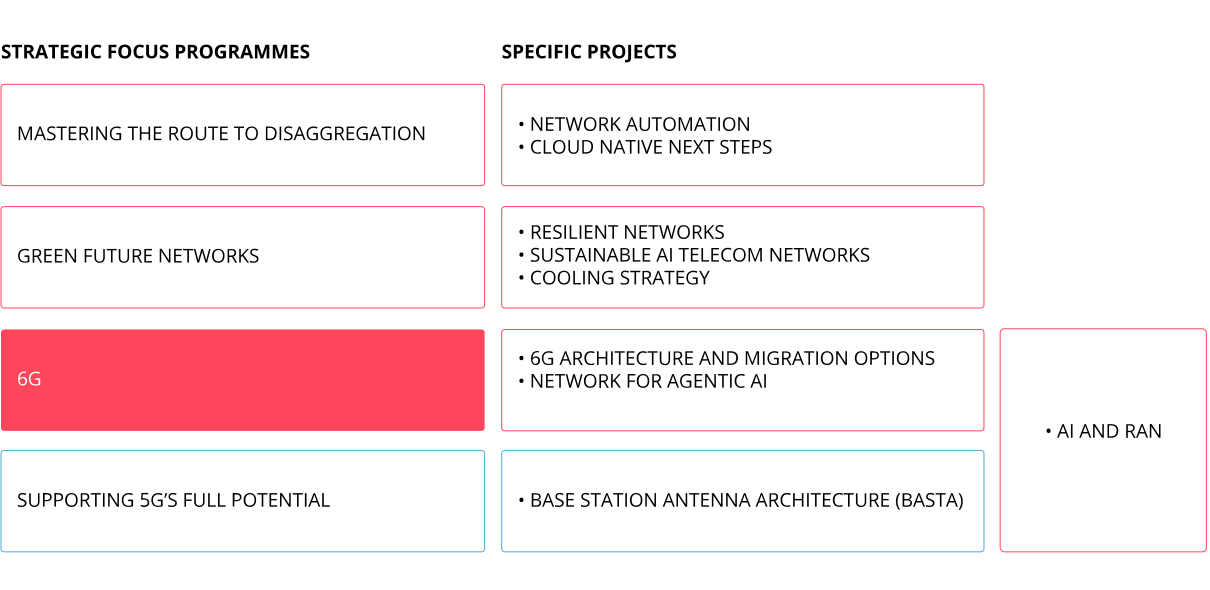
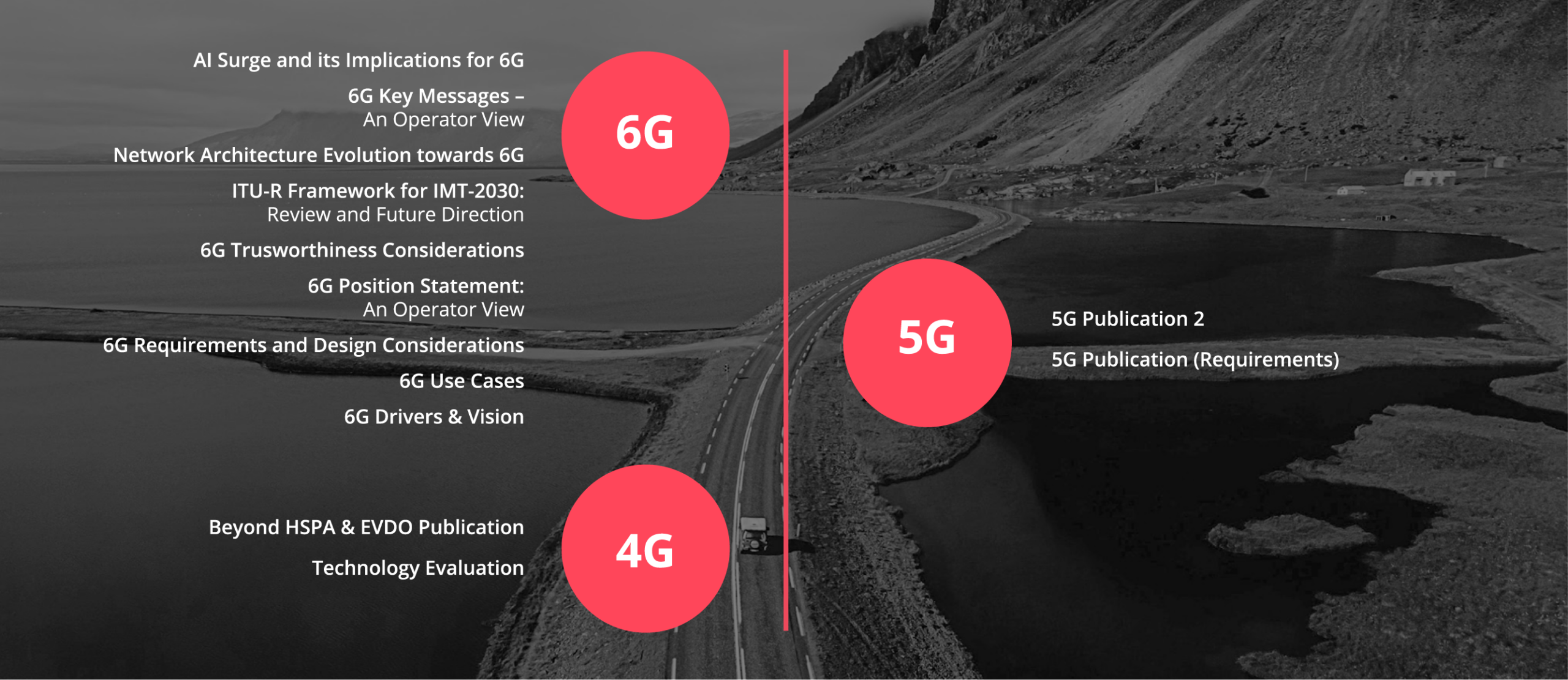
NGMN Work Programme
„As 6G standardisation enters a critical phase, the rapid growth of AI and AI agents presents both opportunities and challenges for mobile network operators.“
Laurent Leboucher
Orange Group CTO and EVP Networks, Chairman of the NGMN Alliance Board
The publication outlines the NGMN perspective on how AI-related requirements should be addressed in the evolution towards 6G. It consolidates mobile network operators’ views on how AI may impact 6G standardisation and provides guidance to support ongoing 6G studies within 3GPP. It examines three key dimensions: the impact of AI-driven traffic on networks, the network capabilities required to support AI-based services, and the role of AI as an enabler for future network architecture evolution.
A harmonised global 6G standard is essential to ensure a smooth industry evolution, address societal needs, and support a healthy ecosystem. The rollout of 6G should avoid mandatory hardware replacement, instead focusing on software upgrades within existing frequency bands. New hardware should only be introduced where new frequencies make it necessary. Any new technologies must demonstrate clear benefits within a techno-economic framework, with a strong emphasis on spectrum and energy efficiency.
Consensus, time and a focus on continuous improvement will be key elements for guiding the evolution of mobile networks towards 6G and beyond, building on the solid foundation of 5G. The Next Generation Mobile Networks Alliance (NGMN) revealed this today while publishing a proposed framework to guide the evolution of network architecture towards 6G.
The “Network Architecture Evolution towards 6G” publication builds on NGMN’s “6G Position Statement – An Operator View”, published in 2023. It advises that the future 6G network architecture should address 5G gaps, support new scenarios and requirements, adapt to RAN changes, and embrace emerging technology trends. NGMN emphasises the importance of allocating sufficient time in the standardisation process to ensure industry-wide collaboration, enabling a smooth and continuous evolution of mobile networks towards 6G and beyond.
Radio metrics such as spectral efficiency, TRS, TRP, and energy consumption should align with the ITU-R IMT-2020 specifications within the 3GPP standards. New RAN solutions must demonstrate clear performance improvements over the benchmarks set in 3GPP Release 18. This framework builds on lessons learned from the 5G Standalone rollout to ensure that assessments are both practical and well-informed.