Building sustainable and environmentally conscious solutions
„Green Future Networks is about turning sustainability into concrete action for the mobile industry. We are addressing Network Resilience, Sustainable AI Telecom Networks and energy-efficient Cooling Strategy to ensure future networks are both high-performing and environmentally responsible. We invite the industry to work with us in shaping a more sustainable and resilient digital infrastructure.“
With Green Future Networks, NGMN is enabling the mobile industry to further transform and meet its environmental and sustainability goals. Since the initiative started in 2021, we have identified the key opportunities and challenges and made actionable recommendations on several key areas.
NGMN Work Programme
Curious about getting involved? Become a NGMN member and contribute directly.
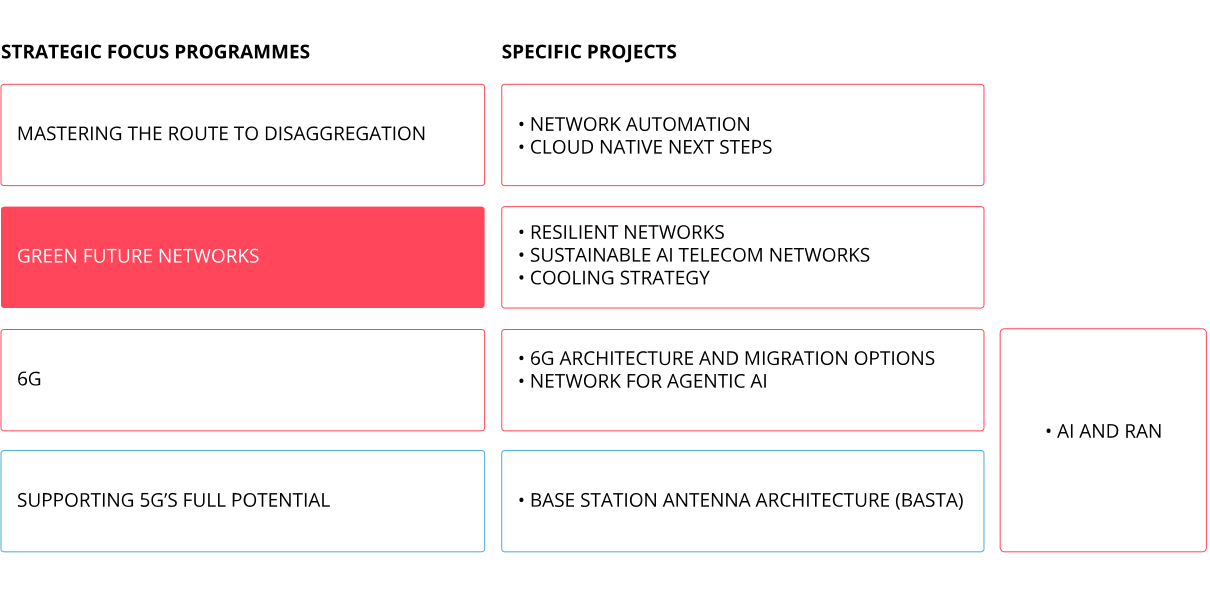
The project focuses on the definition of resilience in the context of telecommunication networks, the introduction of risks and related scenarios and the principles of resistance to these risks.
Sustainable AI Telecom Networks
Defining metrics and measurement methods to characterize AI energy consumption and energy efficiency holistically, from a whole life cycle analysis (LCA) perspective, to enable sustainable AI-native telecom networks.
Cooling Strategy
Identify the common challenges facing Mobile Operators in terms of energy demands and cooling needs, considering data growth; analyse a set of suitable cooling solutions; outline cooling strategies to address a variety of environmental and climate conditions.
Provide a view on mobile operators’ growing concerns about the availability of their network infrastructure and resources required to run the network, as well as on the threats, strategies and related solutions to prevent service disruption.
Besides, present the concept of network resilience from an industrial perspective and highlight best practices and strategies to strengthen the resilience of MNOs’ networks in facing future challenges and ensuring that society remains connected and safe.
Address large-scale deployment of AI in telecom networks, which are increasingly focused on economic and environmental sustainability targets, is subject.
AI energy consumption and energy efficiency
Analysis of sustainable AI for added-value network services
Analysis of sustainable AI for energy-efficient network functionalities
Resource-efficient AI solutions and models
Assessment of trade-offs between AI performance, energy use and operational cost
Evaluation if the current approaches to cooling are fit for purpose in addressing the industry’s environmental sustainability targets and identifying where more harmonisations may be needed.
Cooling for network-side infrastructure (Data Centres and Base Stations including passive and active infrastructure)
Current and future network architecture considerations, especially components more in need of cooling solution optimisations
Building a Sustainable Future for Mobile
Phase 1
2021/22
Metering for Sustainable Networks v1.0
Network Energy Efficiency
Network Equipment Eco-Design and End to End Service Footprint
Sustainability Challenges and Initiatives in Mobile Networks
Phase 2
2022/23
Network Energy Efficiency Phase 2
KPIs and Target Values for Green Network Assessment
Telco Supply Chain Sustainability
Phase 3
2023/24
A Roadmap to Energy Efficient Mobile Networks
Metering in Virtualized RAN Infrastructure
Reducing Environmental Impact
Network Energy Efficiency Phase 3A
Phase 4
2024/25
Metering
Energy Management
Environmental Sustainability and Reporting
Phase 5
2025/26
Resilient Networks
Sustainable AI Telecom Networks
Cooling Strategy
„From both cost and carbon footprint perspectives, energy consumption is one of our industry’s biggest challenges.“
Laurent Leboucher
Orange Group CTO & EVP Networks, Chairman of the NGMN Alliance Board
Publications
Metering in RAN Transport Networks
December 2025
This publication calls for the creation and harmonisation of energy metering standards across 5G RAN transport networks. It emphasises that Mobile Network Operators (MNOs) urgently need accurate, standardised methods to measure energy consumption and to improve energy efficiency across front-, mid-, and backhaul networks — a critical step in reducing operational costs and meeting sustainability targets.
In this deliverable NGMN highlights that energy consumption and efficiency remain insufficiently addressed due to a wide landscape of telecom Standard Development Organisations (SDOs) and further standardisation bodies working on energy metering standards.
The publication, “Green Future Networks: Environmental Sustainability and Reporting”, offers practical recommendations for addressing Scope 3 emissions – those generated across the broader value chain – which represent approximately 90% of total emissions for mobile network operators (MNOs).
NGMN advocates for a shift toward using primary (unit-based) emissions factors rather than traditional financial (price-based) ones to enhance reporting accuracy. The guidance also emphasises the need for greater collaboration and industry-wide alignment of calculation methods.
Green Future Networks: A Roadmap to Energy Efficient Mobile Networks
July 2024
This latest NGMN publication outlines 16 different energy saving techniques and intelligent solutions that are currently used or under development in the industry. Supported by real-world data, the publication highlights the energy saving potential of each solution and classifies each by type and by the time needed to develop and deploy them.
According to the publication, energy consumption can be reduced through process optimisations, engineering and operational improvements, and the deployment of recent technologies. This is the latest phase of NGMN’s Green Future Networks programme, building on the previous publications that addressed the short-term solutions that mobile network operators (MNOs) could deploy.
Green Future Networks:
Metering in Virtualised RAN Infrastructure
April 2024
Being “green”, which entails energy efficiency and sustainability without compromising performance, is increasingly recognised as a hot topic and a prerequisite for enduring success today and in the future.
Through this publication, the NGMN Alliance delivers vital recommendations for industry standards, facilitating more precise and real-time estimations of energy consumed by virtualised or cloud-native network functions. It highlights the necessity of enhancing current 3GPP Virtual Network Function (VNF) / Cloud Network Function (CNF) energy consumption estimation frameworks for more precise measurement of energy consumption by VNF/CNF on shared IT/Cloud infrastructure.
Furthermore, the publication emphasises the implementation and the consideration by standardisation bodies of the Redfish® model published by DMTF as a starting point, and addresses the questions which data/parameters are measured, how, and which standards to align to.